Choosing the right Stone Hammer Crusher is not a simple capacity comparison. It is a site-specific engineering decision. Feed size, rock hardness, moisture, abrasiveness, and required output shape all affect the result. A crusher that performs well in a dry limestone quarry may struggle with wet, sticky claystone.
Mining engineer Dr. S. K. Haldar offers a useful working principle: “Equipment selection must follow the material and operating conditions, not the brochure.” That advice deserves attention. Manufacturers often highlight maximum throughput, yet real production can fall when oversized feed, uneven loading, or worn hammers enter the process. The machine may look powerful on paper. Reality is less tidy.
This guide examines the practical factors behind a dependable Stone Hammer Crusher choice. It considers rotor speed, hammer material, crushing chamber design, motor power, discharge control, maintenance access, and dust-management arrangements. It also explains how to compare quoted capacity with achievable daily output. Those numbers are not always equal.
Watch the feed.
A careful buyer should inspect test samples, review operating records, and ask for wear-life evidence from similar sites. Local technicians matter, too. A technically advanced crusher becomes a poor investment when spare parts arrive slowly or routine inspection is difficult. We will also discuss noise, vibration, guarding, and safe servicing practices.
There is no perfect model. Even a well-designed Stone Hammer Crusher can underperform when installation, feeding, or maintenance is neglected. The goal is a balanced selection, supported by measurable evidence rather than confident promises. That approach may feel slower, but it usually prevents expensive corrections later.
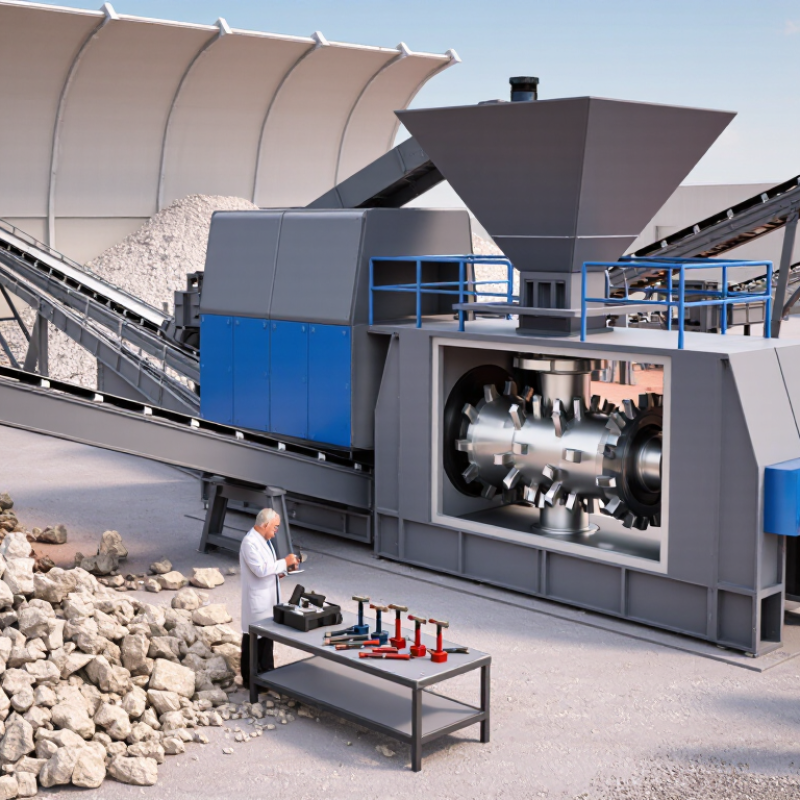
How to Choose the Best Stone Hammer Crusher?
Understanding Stone Hammer Crusher Types and Working Principles
Stone hammer crushers reduce rock through repeated impact. A high-speed rotor drives hammers against incoming material. The broken stone then passes through grate openings. Smaller openings create finer products, but they can increase blockage risks.
Common designs include reversible hammer crushers, ring hammer crushers, and heavy-duty hammer crushers. Reversible models use both hammer faces, improving service life when feed is moderately abrasive. Ring hammer types suit softer coal and limestone applications. Heavy-duty models handle larger feed sizes and stronger impact loads. However, “heavy duty” does not mean unlimited durability.
The US Geological Survey’s Mineral Commodity Summaries 2024 reported roughly 1.8 billion metric tons of crushed stone production in the United States during 2023. This scale shows why output stability matters. The US Department of Energy also identifies grinding and crushing as major energy users across mineral processing. Small design choices can affect operating costs.
Check feed hardness, moisture, maximum lump size, and required product grading. High-moisture clay may stick between the grate bars. Highly abrasive quartz can wear hammers quickly. In field inspections, uneven feeding often causes vibration and uneven wear. A stable feeder matters.
Measure twice.
Select a crusher with accessible inspection doors, replaceable wear parts, and clear safety interlocks. Rotor speed should match the material, not simply the desired capacity. A faster rotor may produce finer stone, yet it can raise dust, noise, and wear. The wrong choice is possible even with a detailed calculation. Geological testing remains essential.
Material behavior should guide the decision, not appearance. Limestone usually breaks easily, while granite contains harder, more abrasive minerals. Moisture also matters. Wet fines can stick inside the crushing chamber and reduce effective output. Check compressive strength, silica content, abrasiveness, feed size, and desired product shape before selecting a hammer crusher.
The U.S. Geological Survey reported approximately 1.5 billion metric tons of crushed stone production in 2023. This scale shows why capacity planning cannot rely on catalog figures alone. Measure the feed rate at the actual site. Then allow practical room for moisture, uneven feeding, maintenance, and screen limitations.
A crusher rated at 100 tonnes per hour may deliver less under difficult conditions. It is not enough.
For abrasive granite, repeated hammer and liner replacement can raise operating costs quickly. For softer limestone, a hammer crusher may produce suitable fine material with fewer crushing stages. Compare the required output with the target product size, not just the maximum feed capacity. The European Commission’s Best Available Techniques guidance also emphasizes energy use, dust control, and process efficiency in mineral operations. A perfect forecast is impossible. Recheck assumptions after several production shifts. Field measurements often reveal problems that laboratory samples miss.
Choosing a stone hammer crusher starts with the rotor, not the catalog capacity. A balanced rotor reduces vibration and keeps impact energy consistent. A heavier rotor can improve inertia, but it may increase starting power and bearing loads. Open rotors usually release material faster, while enclosed designs can improve control with harder feed. The U.S. Geological Survey’s Mineral Commodity Summaries 2024 estimated U.S. crushed stone production at about 1.5 billion metric tons in 2023. At this scale, small efficiency losses become costly.
Hammer quality directly affects crushing performance and maintenance intervals. Look for high-chrome or manganese alloy options, depending on silica content and moisture. Hardness resists abrasion, but excessive hardness can make hammers brittle. Toughness matters when feed contains tramp rock. Measure output size, power draw, wear rate, and downtime together. A crusher producing fine material may still perform poorly if recirculation rises. CEEC International reviews indicate comminution can consume roughly 25–50% of mine-site energy, depending on the circuit and material. Those figures deserve attention, although site conditions can distort comparisons.
Tips: Test the actual feed before purchase. Record rotor speed, discharge gap, moisture, and product grading. Ask for wear data from similar stone, not laboratory samples alone. Inspect hammer edges after several shifts. A perfect rotor on paper may disappoint in a dusty quarry. My own checklist would also include bearing temperature and vibration trends, because early warning is often missed.
| Comparison Dimension | Heavy-Duty Reversible Hammer Crusher | Single-Rotor Hammer Crusher | Two-Stage Hammer Crusher | Ring-Hammer Crusher |
|---|---|---|---|---|
| Typical Application | Medium-hard limestone, gypsum, coal, and aggregate recycling where reversible operation can extend wear life. | Primary or secondary crushing of limestone, marl, shale, and other moderately abrasive materials. | High-reduction crushing of relatively soft to medium-hard materials when a fine product is required in one pass. | Coal and other relatively soft materials where controlled impact and reduced over-crushing are important. |
| Rotor Design | Symmetrical rotor that can reverse direction, allowing both hammer edges to be used before replacement. | Fixed-direction rotor with a compact hammer arrangement and a comparatively simple drive system. | Two impact stages or two rotors arranged to increase reduction within a single machine. | Rotor fitted with ring-shaped hammers that swing or pivot to absorb impact and reduce blockage risk. |
| Rotor Speed Range | Approximately 600–1,200 r/min, depending on rotor diameter, feed size, and material hardness. | Approximately 800–1,500 r/min; higher speed generally increases fines and energy demand. | Approximately 800–1,500 r/min, with the final setting selected according to the desired product size. | Approximately 500–1,000 r/min, generally lower than fine-crushing hammer configurations. |
| Recommended Maximum Feed Size | Typically 200–500 mm, subject to crusher size and feed opening. | Typically 150–400 mm for medium-scale stone crushing duties. | Typically 100–300 mm, because the machine is designed for substantial size reduction. | Typically 100–300 mm, with a controlled and relatively uniform feed preferred. |
| Typical Product Size | 10–80 mm, adjustable through grate spacing, rotor speed, and discharge configuration. | 10–60 mm, depending on the grate opening and operating conditions. | 3–25 mm, making it suitable for applications requiring a finer final product. | 10–50 mm, with relatively good control of top-size material. |
| Typical Reduction Ratio | Approximately 10:1 to 20:1 for suitable medium-hard feed materials. | Approximately 8:1 to 15:1, influenced strongly by rotor speed and grate setting. | Approximately 15:1 to 30:1 when the feed is properly controlled and not excessively abrasive. | Approximately 6:1 to 12:1, prioritizing stable operation and reduced fines generation. |
| Hammer Material | Forged or cast alloy steel with a replaceable wear face; toughness is important because of large impact loads. | Heat-treated alloy steel or manganese-alloy steel selected according to feed abrasiveness and impact intensity. | High-toughness alloy steel is preferred because the rotor and hammers experience repeated high-energy impacts. | Hardened alloy steel or manganese steel rings designed to tolerate repeated impact and controlled swinging movement. |
| Hammer Hardness and Toughness | Commonly balanced around 45–60 HRC; excessive hardness can increase cracking under heavy impact. | Often selected in the range of 45–60 HRC, depending on whether abrasion or impact is dominant. | Usually requires a tough wear-resistant grade, often around 50–60 HRC after heat treatment. | Moderate-to-high toughness is prioritized over extreme hardness to prevent brittle fracture of the rings. |
| Wear Resistance | High when reversible operation is used correctly; wear can be distributed across both hammer edges. | Medium to High; performance declines faster when processing silica-rich or highly abrasive rock. | Medium; excellent reduction is possible, but abrasive feed can accelerate hammer and grate wear. | Medium to High for coal and soft stone; not the first choice for highly abrasive hard rock. |
| Crushing Performance | Stable output, good impact efficiency, and practical operation for variable feed when the rotor is correctly balanced. | Reliable general-purpose crushing with straightforward adjustment and a broad range of capacity options. | High reduction and a fine product in one machine, but it requires consistent feed and careful wear monitoring. | Consistent crushing of soft feed with lower risk of plugging and moderate production of unwanted fines. |
| Capacity Suitability | Medium to high capacity; suitable for quarry, aggregate, and mineral-processing lines. | Low to high capacity; commonly selected for flexible primary or secondary duties. | Medium capacity; best where high reduction is more important than maximum throughput. | Medium to high capacity for coal-handling and similar soft-material applications. |
| Energy Consideration | Moderate energy demand; reversing the rotor does not itself reduce power draw, but it can improve hammer utilization. | Moderate to high energy demand at high rotor speeds or when producing a large proportion of fines. | Higher energy demand per tonne may occur because the material is subjected to multiple impact stages. | Generally moderate energy demand because ring hammers operate at comparatively lower impact intensity. |
| Maintenance Requirements | Inspect hammer edges, rotor balance, grate condition, bearings, and reversible-direction controls. | Inspect hammer wear, grate clearance, rotor balance, bearings, and discharge blockage points. | Requires frequent inspection of both impact stages, hammer locking systems, grates, and internal liners. | Inspect ring movement, suspension points, hammer openings, liners, and material-flow passages. |
| Best Choice When | You need dependable medium-to-high throughput, reversible wear utilization, and versatility with moderately hard stone. | You want a simple, widely applicable machine for standard limestone and general aggregate crushing. | You need a fine product and a high reduction ratio from a single crushing stage. | You process coal or soft stone and want controlled impact with lower risk of plugging. |
How to Choose the Best Stone Hammer Crusher?
Choosing a stone hammer crusher starts with the motor, not the brochure. Check feed size, hardness, moisture, and required tonnes per hour. The U.S. Department of Energy’s Industrial Motor Systems Market Assessment reports that motor-driven equipment consumes about 68% of manufacturing electricity. Power selection therefore affects operating cost. Request measured kW load, starting current, and expected duty cycle. A barely adequate motor may stall in wet, sticky stone. Oversizing wastes capital and can hide poor process control. Keep a margin. Not an excuse for guesswork.
Maintenance access should be checked with a tape measure. Can a technician reach the blow bars, rotor, bearings, lubrication points, and inspection doors safely? Specify removable guards, lifting lugs, lockable isolation points, and space for a maintenance hoist. The U.S. Bureau of Labor Statistics recorded 5,283 fatal work injuries in 2023. This total covers all industries, not crushers, but it shows why access and isolation matter. Time a routine inspection with the plant stopped and isolated. Real conditions reveal weaknesses.
Safety features need testing, not decorative checkboxes. Require emergency stops, interlocked doors, zero-speed detection, overload protection, and dust-control connections. MSHA’s 2023 fatality summaries continue to identify machinery and powered-haulage events as recurring mining hazards. Confirm guarding against fragments, noise, and unexpected restart. Ask for manuals, inspection intervals, and training records. I would inspect cable routing after rain. Small details fail first. A spreadsheet cannot replace a technician beside the machine.
Compare typical crusher classes by motor power, maximum feed opening, and planned maintenance clearance. Compact units commonly use around 30 kW motors, while medium and heavy-duty units may require approximately 75 kW and 132 kW respectively.
Before selection, confirm the actual feed size, required capacity, available electrical supply, access for hammer and liner replacement, emergency stops, guarding, dust control, and lockout/tagout provisions. Values shown are typical planning figures, not brand-specific specifications.
Supplier reliability deserves the same attention as crushing capacity.
The U.S. Geological Survey’s Mineral Commodity Summaries 2024 estimated U.S. crushed-stone output at about 1.5 billion metric tons in 2023. Such scale makes equipment downtime expensive. Ask for documented operating references, spare-parts lead times, service response records, and warranty exclusions. A polished brochure is not evidence. Factory audits and video inspections reveal more.
Compare total cost over three to five years, not only the purchase quotation.
Include electricity, rotor replacement, blow bars, lubrication, labor, transport, installation, and lost production. The International Energy Agency repeatedly identifies energy efficiency as a major industrial cost lever. Therefore, request measured power data under a comparable feed rate. Check the test conditions carefully. “Low consumption” can hide a smaller feed size or lower output.
Application fit is less dramatic, but more decisive.
Match the crusher to feed hardness, moisture, maximum size, required product curve, and daily tonnage. A quarry processing abrasive granite needs different wear protection from a site handling softer limestone. Ask for test results using representative rock samples. Field experience helps here.
I once saw a unit selected by horsepower alone; its discharge setting was unsuitable, and rework followed. That choice looked efficient on paper. It was not.
Allow room for seasonal moisture, uneven feeding, and future capacity changes.