Skip to content

How to Choose the Best CNC Die Welding Machine

Choosing the right Cnc Die Welding Machine requires more than comparing prices, laser power, or attractive photographs. The machine must match your die material, repair depth, production rhythm, and operator skill. A tool designed for small mold corrections may fail during repeated repairs on large automotive dies. That difference matters.

Dr. John C. Lippold, a respected welding-metallurgy authority, states, “Weldability is not simply a material property; it depends on the process, design, and service conditions.” This principle deserves attention. Buyers should examine heat control, wire compatibility, pulse stability, microscope clarity, and cooling performance. Ask for test welds on your actual steel grade. Inspect the bead under magnification. Check whether the repaired edge can be machined without tearing or excessive hardness. Small details reveal large problems.

A reliable Cnc Die Welding Machine should also provide repeatable settings, accessible maintenance, and documented electrical safety. Request duty-cycle data, calibration records, training support, and spare-parts availability. Speak with technicians who use the machine daily, not only sales representatives. Their comments may expose vibration, awkward controls, or slow wire feeding. Those issues are easy to overlook during a short demonstration.

No machine is perfect. I would still question impressive specifications without production evidence. The best choice may not be the most powerful model. It may be the one that produces clean, controlled repairs at the required scale, with fewer rejected dies and less finishing work. A careful evaluation protects both quality and budget.
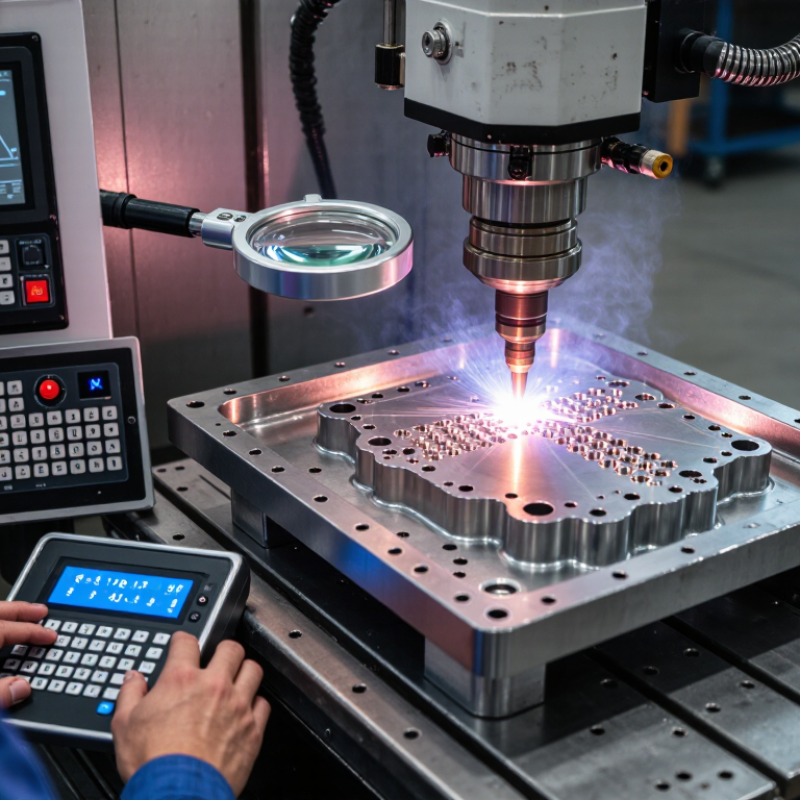
How to Choose the Best CNC Die Welding Machine

Understanding CNC Die Welding Machine Functions and Applications

Choosing a CNC die welding machine starts with its working functions, not its advertised speed. The system should control welding current, wire feed, torch movement, and heat input with repeatable precision.

Look for programmable paths, automatic seam tracking, stable clamping, and real-time parameter recording. These features matter when repairing cavities, parting lines, and worn edges on injection molds or forging dies.

The application decides the machine’s value. For small mold repairs, a compact torch and fine wire control can reduce excess metal and grinding. Larger forging dies need stronger fixtures, longer travel, and reliable heat management.

According to World Robotics 2024, factories installed 541,302 industrial robots worldwide in 2023. This shows growing trust in repeatable automation, but the figure does not measure die welding directly. That distinction matters.

Experienced technicians should also inspect accessibility around deep cavities and narrow corners. A technically powerful machine may still fail when the torch cannot reach the repair zone.

AWS’s 2023 workforce research projected a shortage of 330,000 welding professionals by 2028, increasing the value of intuitive controls and training records. Still, automation does not remove judgment.

Poor surface cleaning, incorrect preheating, or weak fixture alignment can ruin a precise program. Test welds on matching tool steel first. Review hardness, distortion, and finish quality before production.

Some machines appear efficient, yet their setup time remains easy to underestimate.

Assessing Die Materials, Welding Methods, and Production Requirements

How to Choose the Best CNC Die Welding Machine

Assessing Die Materials, Welding Methods, and Production Requirements

Selecting a CNC die welding machine starts with the die material, not advertised power. Tool steel, hardened steel, aluminum, and cast alloys react differently to heat. For tool steel repairs, controlled pulsed welding can limit cracking and reduce the softened zone. Cast alloys demand care. Check filler compatibility, preheating needs, and post-weld hardness before comparing machines. Ask for measured weld samples using your actual die grade. This evidence is more useful than a polished brochure.

Your production target should shape the welding method. Laser welding suits precise edges, fine cracks, and low heat input. Micro-TIG can offer stronger deposition for deeper repairs, although operator skill matters greatly. That trade-off is easy to underestimate. For frequent repairs, review wire feeding, microscope visibility, torch movement, cooling, and parameter storage. A machine that saves setup time may outperform a faster machine with awkward controls. Measure cycle time on the shop floor. Include loading, cleaning, inspection, and parameter changes.

Reliability depends on repeatability, service access, and training. During evaluation, record bead width, penetration, hardness, and distortion across several operators. One successful sample proves little. Ask how calibration is verified and how faults are documented. Consumable availability and clear maintenance instructions also protect production continuity. I have learned that small alignment errors can create expensive rework. Do not ignore them. An honest trial may reveal that your preferred welding process is unsuitable for one die material. That finding is useful.

Comparing Machine Precision, Power, Automation, and Control Systems

Choosing a CNC die welding machine requires comparing precision, power, automation, and control quality. In die repair, precision begins with positioning, not marketing claims. Request volumetric accuracy, repeatability, and test conditions aligned with ISO 230-2. A 0.01-millimeter figure means little without temperature, travel length, and measurement method. Watch the weld path.

Power selection should follow alloy, thickness, and heat sensitivity. A stable pulsed arc, adjustable current, and controlled duty cycle can reduce distortion around thin edges. Excessive power may create a hard heat-affected zone. Insufficient power can cause incomplete fusion. The International Federation of Robotics recorded 541,302 industrial robot installations worldwide in 2023, showing automation’s growing industrial role. Yet automation cannot replace careful setup. Calibration still matters.

Control systems should store welding parameters, record energy use, and restrict unauthorized changes. Deloitte’s 2024 Smart Manufacturing and Operations Survey found that 86% of manufacturing leaders viewed smart manufacturing as a major competitiveness driver. Look for recipe management, alarm history, remote diagnostics, and clear recovery instructions. Test the interface with gloves. Test it under bright shop lighting. A machine can be mechanically precise but poorly controlled. I would also weld a representative die sample, then inspect bead height, penetration, and distortion. Reports are useful. Real samples are harder to ignore.

How to Choose the Best CNC Die Welding Machine - Comparing Machine Precision, Power, Automation, and Control Systems

Evaluation Dimension Entry-Level CNC Die Welding System Precision Pulsed-Laser CNC System High-Power Fiber-Laser CNC System Robotic or Multi-Axis CNC Welding Cell
Typical welding process Operator-assisted laser or micro-TIG repair welding Pulsed laser welding for localized die and mold repair Continuous or modulated fiber-laser welding for larger repairs Automated laser welding with programmed multi-axis motion
Best suited die materials Common tool steels and small repair areas Tool steel, stainless steel, hot-work steel, and carbide-compatible applications Tool steel, stainless steel, aluminum alloys, and larger steel components Validated materials and geometries requiring repeatable production repair
Typical laser or welding power Approximately 100–300 W pulsed laser or low-current micro-TIG Approximately 100–400 W average pulsed laser power Approximately 1–3 kW continuous-wave fiber-laser power Approximately 1–6 kW, depending on material thickness and production rate
Typical weld penetration Up to about 0.5–1.0 mm per pass, depending on process and material Commonly about 0.2–1.5 mm per pass for controlled repair work Commonly about 1–4 mm per pass, depending on power, focus, and travel speed About 1–6 mm per pass when process parameters and joint geometry are suitable
Positioning accuracy Typically ±0.03–0.05 mm Typically ±0.01–0.03 mm with a calibrated motion system Typically ±0.02–0.05 mm, depending on machine size and axis configuration Typically ±0.03–0.10 mm for the complete robot or multi-axis system
Repeatability Approximately ±0.02–0.05 mm Approximately ±0.01–0.02 mm Approximately ±0.02–0.05 mm Approximately ±0.03–0.08 mm, depending on calibration and payload
Recommended work area Small dies and localized repair zones; approximately 200 × 200 mm Small to medium dies; approximately 300 × 300 mm to 600 × 400 mm Medium to large dies; approximately 600 × 400 mm to 1,500 × 800 mm Large or irregular dies within the robot envelope or rotary-axis capacity
Motion axes Usually 3 linear axes; manual positioning may be required Usually 3 linear axes, with optional rotary or tilting axis Usually 3–5 controlled axes Typically 5–7 axes, including a robot arm and positioner
Automation level Low to moderate; operator controls setup, alignment, and parameter changes Moderate to high; stored programs control motion and pulse parameters High; automatic motion, power modulation, wire feeding, and parameter recipes may be available Very high; supports programmed paths, sensors, part handling, and production integration
Control system requirements Basic CNC controller with manual jog, parameter presets, and emergency circuits CNC motion controller with pulse-width, frequency, energy, and travel-speed control Advanced CNC or PLC control with real-time laser power and motion coordination Integrated robot controller, PLC, safety controller, sensing, and production data interfaces
Path programming Simple point-to-point programming or manual teaching 2D/3D CAD import, teach-in functions, and repeatable repair paths CAD/CAM programming, contour following, and synchronized multi-axis interpolation Offline programming, 3D scanning, robotic path planning, and adaptive path correction
Heat-affected zone Low to moderate; depends strongly on operator technique Very small and well controlled, making it suitable for fine die edges Small but higher total heat input than pulsed repair systems Controlled through programmed speed, power modulation, and interpass cooling
Wire or filler integration Manual filler addition is common Optional automatic wire feeder for consistent filler delivery Usually compatible with automatic wire feeding for deeper or wider repairs Closed-loop or synchronized wire feeding is available for production applications
Inspection and sensing Visual inspection and manual measurement Vision alignment, coaxial viewing, and optional height sensing Vision, height sensing, seam tracking, and optional melt-pool monitoring 3D scanning, laser seam tracking, melt-pool monitoring, and automated inspection options
Typical productivity Best for occasional repair and low-volume work Best for fine, high-value repairs where accuracy is more important than deposition rate Best for higher deposition rates and larger repair volumes Best for repeat production, multiple dies, and reduced operator dependency
Operator skill requirement High manual skill is required for consistent results Moderate to high; process knowledge and laser safety training are essential Moderate to high; parameter development is important because heat input is greater High during integration and programming, but lower during routine operation
Safety provisions Local shielding, eye protection, fume extraction, and emergency stop Class 4 laser safeguards, interlocked enclosure, viewing protection, and fume extraction Fully enclosed laser area, interlocks, beam protection, fume extraction, and thermal safeguards Integrated cell guarding, safety scanners, interlocks, emergency circuits, and laser-rated enclosure
Recommended selection priority Low initial investment, flexibility, and occasional repair Maximum precision, minimal distortion, and small repair zones Higher power, faster deposition, and larger repair areas High throughput, consistent quality, traceability, and reduced manual handling
Selection note: The figures shown are typical engineering ranges rather than guaranteed machine specifications. Actual precision, penetration, productivity, and heat input depend on die material, joint geometry, laser spot size, pulse settings, shielding gas, filler wire, fixturing, calibration, and operator training.

Checking Compatibility, Safety Features, Maintenance, and Operating Costs

Choosing the best CNC die welding machine starts with compatibility. Check the die material, dimensions, welding method, and required power range. A machine may appear versatile but still produce weak joints on hardened steel. Measure your largest die and smallest repair area before comparing specifications. Ask for test-welding records, not only sales claims.

Safety features deserve close attention. Look for guarded work zones, emergency stops, interlocked doors, fume extraction, and clear temperature controls. Operators should reach controls without leaning across the welding area. In my workshop experience, a misplaced cable caused more trouble than the welding process itself. Small details matter. Training records, protective equipment, and documented operating procedures also support safer daily work.

Maintenance affects both output and operating costs. Inspect welding heads, clamps, cooling lines, filters, and software alarms on a fixed schedule. Keep replacement parts available for components that wear quickly. A cheaper machine can become expensive when calibration takes hours or service support is slow. Track electricity use, consumables, labor time, and rejected repairs for several weeks. My early cost estimates missed downtime, which made the final calculation unreliable. Leave room for maintenance delays and operator learning. A practical choice should fit your production space, staff skills, repair volume, and budget without forcing unsafe shortcuts.

How to Choose the Best CNC Die Welding Machine

Recommended evaluation weighting for compatibility, safety, maintenance, and operating costs

Compatibility receives the highest weighting because the machine must match the die material, dimensions, welding process, and production volume. Safety features are essential for reducing operator risk, while maintenance requirements and operating costs affect long-term productivity and total ownership cost. Use these percentages as a practical purchasing benchmark and adjust them to your workshop’s requirements.

Selecting the Best CNC Die Welding Machine for Long-Term Value

How to Choose the Best CNC Die Welding Machine

Selecting the Best CNC Die Welding Machine for Long-Term Value

Long-term value begins with repeatable repairs, not the lowest purchase price. A CNC die welding machine should control heat input, wire speed, torch movement, and cooling intervals. These details matter when rebuilding sharp die edges or filling small cavities. McKinsey research reports that predictive maintenance can reduce machine downtime by 30–50%. Therefore, inspect the machine’s diagnostic functions, sensor access, and maintenance records before buying.

Total cost also includes training, consumables, calibration, electricity, and service response. Deloitte’s 2024 Smart Manufacturing and Operations Survey found that 86% of manufacturers see smart manufacturing as important for competitiveness within five years. That finding supports choosing open data connections and practical monitoring tools. However, automation alone cannot fix poor programming or weak operator training. I have seen impressive specifications fail during production because fixtures were unstable. That is an uncomfortable detail, but it deserves attention.

Tips: Request a sample weld on your actual die material. Measure bead width, hardness, distortion, and repair time. Ask for spare-part availability and technician response times. Compare five-year operating costs, not only the quotation. Leave room for uncertainty; material variation can change results. A simple trial run may reveal more than a polished demonstration.