How to Choose TPV Material for Your Product in 2026?
Choosing a Tpv Material in 2026 starts with the job the part must do, not a grade name or a supplier’s headline claim. A dashboard seal, a soft-touch handle, and a flexible fluid connector face very different demands. Heat near an engine, repeated bending, skin oils, cleaning agents, and outdoor sunlight can all change performance. That matters.
The term TPV covers materials with varying polymer bases, hardness, additives, and processing behavior. Two grades may feel similar in a hand sample yet behave differently after weeks of compression or contact with oil. Check technical data sheets for test conditions, then compare results with your actual temperature range, exposure, and expected service life. A datasheet is a starting point, not a guarantee. Ask suppliers about molding conditions, color options, and documented compatibility with the substances your product will encounter.
A practical selection process also weighs production needs. Confirm that the grade can fill the part’s thin sections, release cleanly from the mold, and bond as required in a multi-material assembly. Trial parts can reveal issues that a specification table misses, such as a tacky surface or a seal that takes too long to recover. Sometimes the first choice is wrong. That is useful information, if testing catches it early. This guide explains how to compare TPV grades, validate key claims, and balance performance, manufacturability, and cost before making a decision.
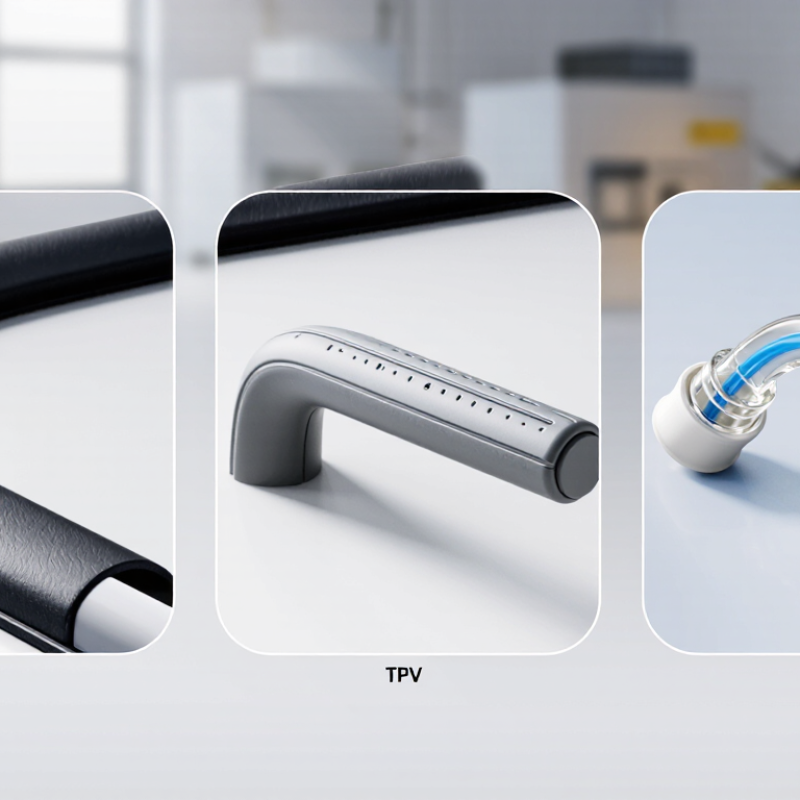
Define Your Product’s Application and Operating Requirements
Define Your Product’s Application and Operating Requirements
Start with the part’s real job, not the TPV label. A door seal faces repeated compression, weather, and body oils. A pump diaphragm may encounter fluids, pressure, and thousands of flex cycles. Write down the contact materials, continuous and peak temperatures, expected loads, UV exposure, and service life.
PlasticsEurope’s Plastics—The Fast Facts 2024 reports 413.8 million tonnes of global plastics production in 2023. That figure describes a vast materials market, not a suitable TPV grade. The details of your part matter more.
Translate requirements into testable targets. Check tensile strength and elongation using ASTM D412, tear strength using ASTM D624, and compression set using ASTM D395. Ask for test conditions, too; results from different temperatures or aging periods may not compare. Also check molding method, wall thickness, tolerance, and how the TPV bonds to nearby materials. A small design detail can change performance. It is easy to overlook.
Tips: Make a simple operating-condition table before requesting samples. Test molded parts after heat and fluid exposure, not just fresh plaques. If one requirement is still a guess, mark it clearly and verify it before finalizing the grade.
Compare Key Performance and Processing Properties
Choosing TPV in 2026 means balancing what the part must endure with how it will be made. Compare hardness, tensile strength, tear resistance, and compression set against real use conditions. A door seal that stays compressed in summer needs different priorities from a flexible grip exposed to repeated bending. Fit matters. Check the expected temperature range and contact with oils, cleaners, or sunlight; resistance varies by grade. A softer compound may feel comfortable, yet deform more under sustained load. Not always. Review test data for the exact grade, rather than relying on a generic TPV description. If possible, test molded samples under conditions that resemble the finished product.
Processing properties can change the choice just as much as service performance. For injection molding, ask whether the grade fills thin ribs and releases cleanly at the planned cycle time. For extrusion, assess melt stability and whether the profile holds its shape after cooling. Follow the grade’s processing guidance for temperature, drying, and screw setup; requirements are not identical across formulations. Watch for flash, uneven surfaces, or dimensions that drift between runs. These clues can point to a mismatch between material and process, though tooling and settings may also be responsible. Regrind may be usable, but repeated heat history can affect consistency. A small production trial is less tidy than a datasheet comparison, and usually more revealing.
How to Choose TPV Material for Your Product in 2026?
Compare key performance and processing properties
The bars show broad, indicative tensile-strength ranges in MPa; actual values depend on formulation, hardness, test method, and grade. TPV is a thermoplastic elastomer that can generally be melt-processed and reprocessed. By contrast, cured EPDM is a thermoset and cannot be remelted. When selecting a grade, also check operating temperature, oil and chemical exposure, compression set, required hardness, and the supplier’s processing recommendations.
Check Regulatory, Sustainability, and Compatibility Needs
How to Choose TPV Material for Your Product in 2026?
Check Regulatory, Sustainability, and Compatibility Needs
A TPV grade can look ideal on a sample sheet and still fail in service. Start with the finished product’s market, use, and exposure. For food-contact, medical, electrical, or automotive applications, identify applicable rules before comparing grades. Requirements vary by region and intended use. Request current composition disclosures, applicable conformity statements, and test results from suppliers. Then verify the finished part, not just the raw material. Small details matter.
Sustainability claims need evidence. The OECD’s Global Plastics Outlook (2022) estimated that 353 million tonnes of plastic waste were generated worldwide in 2019; only 9% was recycled. That figure covers plastics broadly, not TPV alone. Ask for product-specific recycled-content data, recyclability guidance, and lifecycle information. Check whether the material’s color, additives, or bonded construction complicate recovery. The answer may be inconvenient.
Compatibility testing is equally practical. Expose molded samples to the actual oils, cleaners, sunlight, and temperature cycles they will face. Measure hardness, dimensional change, adhesion, and compression set after aging. A neat lab result may not predict a rough production line. It’s worth testing. Document the conditions and acceptance limits, then revisit them when the formulation or supplier changes. I would not treat one successful test as permanent proof.
Validate the Material Through Testing and Supplier Review
Choosing TPV for a product means checking more than a data sheet. Start with the real conditions: operating temperature, repeated flexing, contact with oils or cleaners, and expected service life. A soft sample may feel right by hand yet deform under sustained compression. Small details matter. Record the part’s wall thickness, surface finish, and molding conditions before comparing grades.
Test candidate material in a shape and process close to production. Measure hardness, tensile behavior, compression set, and dimensional change after heat or chemical exposure. Run a molding trial, too; flow, shrinkage, and surface appearance can shift with tool design. Compare results against written acceptance limits, not memory. A tidy lab result can still mislead if the test misses actual use. That is easy to overlook.
Tips: Ask suppliers for traceable test data, batch-to-batch variation, and clear change-control practices. Review how samples were conditioned and tested. Request help interpreting gaps, not just favorable figures. Keep a retained sample from each approved lot. Supplier answers may sound confident, but verify the details against your own trial results.