A rotary desiccant dehumidifier controls moisture with a slowly turning wheel coated in a moisture-attracting material. One side absorbs water vapor from process air; a separate stream of heated air dries the wheel for reuse. The result is moisture removal without relying only on cooling air below its dew point. You can picture the wheel turning between two sealed air paths, with dry supply air leaving one side.
ASHRAE’s Handbook—HVAC Systems and Equipment, in its coverage of desiccant dehumidification equipment, describes system configurations and performance considerations. The U.S. Department of Energy’s Better Buildings guidance also treats humidity control as part of efficient building operation. These references matter because real performance depends on inlet humidity, regeneration temperature, airflow, and heat recovery—not one headline rating. Conditions matter.
Dr. William C. Worek’s published technical work on desiccant systems emphasizes moisture transfer as a distinct approach to humidity control; put simply, the wheel captures vapor and releases it during regeneration. That distinction helps explain why these units appear in food processing, pharmaceutical production, and cold-storage facilities, where damp air can affect products or processes. Yet a rotary desiccant dehumidifier is not automatically the best choice: regeneration heat can add energy demand, and results vary with design and operating conditions. A dry room is useful, but not free.
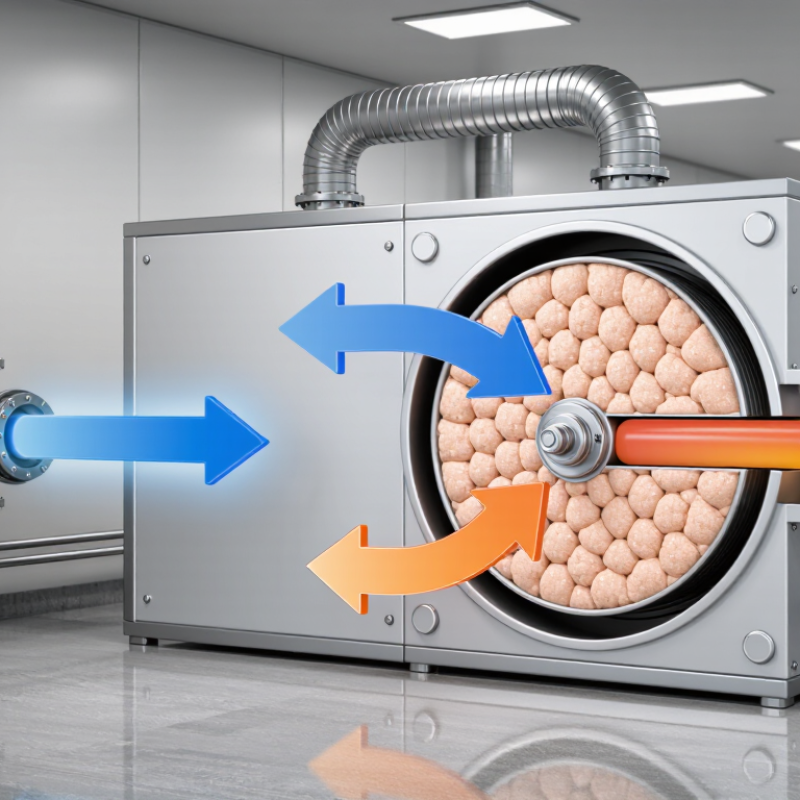
A rotary desiccant dehumidifier removes water vapor using a slowly turning wheel coated with a moisture-attracting material. This wheel is often called a desiccant rotor. Damp process air passes through one section, where the coating adsorbs water molecules. The air leaves drier, while the rotor gradually becomes moisture-loaded.
The process is adsorption, not condensation on a cold coil.
The wheel keeps turning. A separate stream of heated air passes through another section and releases the captured moisture. That humid regeneration air is then discharged, while the cleaned section returns to the process airflow. The two air streams remain separated by seals, though small leakage can occur in real equipment.
Warm, dry air emerges. That matters in cold spaces, where cooling coils may struggle to remove moisture. The exact result depends on airflow, rotor speed, inlet humidity, and regeneration temperature. More heat is not always better; it can raise energy use without improving the final air enough. A rotor also needs maintenance. Dust buildup can reduce airflow and moisture transfer, a detail that is easy to overlook.
What Is a Rotary Desiccant Dehumidifier?
A rotary desiccant dehumidifier removes water vapor with a slowly turning honeycomb rotor. Process air passes through one section, where desiccant surfaces capture moisture. A separate heated airstream dries another section, and rotation returns regenerated material to service. It runs continuously.
Inside the rotor, material choice changes performance. Silica gel has a porous surface that adsorbs water across many common drying conditions. It can suit applications needing steady, moderate humidity control. Molecular sieves have tightly defined pores and can hold water strongly, helping achieve lower outlet dew points in demanding applications. The tradeoff is real: regeneration conditions, energy use, and incoming air all affect the result. It depends.
Air channels matter as much as chemistry. Narrow passages increase contact area but can raise pressure drop and fan demand. Wider passages may move air easily, yet leave less time for moisture transfer. Rotor coating, channel shape, speed, and airflow must work together. Dust or uneven airflow can undermine a sound material choice; a clean-looking rotor alone proves little. Measurements at the inlet and outlet help reveal inconsistent drying. Even a well-sized rotor can disappoint when airflow is poorly balanced.
| Rotor component or material | What it does | Key characteristics | Typical considerations |
|---|---|---|---|
| Silica gel | Adsorbs water vapor from process air as the rotor turns through the dehumidification sector. | A porous form of amorphous silica. Its pore structure and surface chemistry support water adsorption over a range of humidity conditions. | Performance depends on the silica formulation, air conditions, and regeneration temperature. It is commonly used in desiccant rotors. |
| Molecular sieves (zeolites) | Adsorb water within crystalline pores as process air passes through the rotor. | Zeolites have regularly structured micropores. Common types such as 3A and 4A have nominal pore openings of about 3 and 4 angstroms, respectively. | Can be selected for demanding low-dew-point conditions. The suitable grade and regeneration conditions depend on the system design. |
| Honeycomb air channels | Provide many narrow passages that guide air through the adsorbent-coated rotor structure. | The channel geometry provides air-to-adsorbent contact while allowing airflow. The channels are passages, not the desiccant itself. | Channel size, rotor depth, airflow, and pressure drop are design trade-offs. Dust or deposits can restrict airflow and reduce performance. |
| Rotor matrix and binder | Supports the honeycomb shape and holds the desiccant in place as the wheel rotates between air sectors. | Rotor construction varies; it commonly uses a structured support impregnated or coated with desiccant. | Material choice must suit the required strength, temperature range, airflow, and resistance to operating conditions. |
| Rotating adsorption and regeneration | A portion of the wheel adsorbs moisture from process air while another portion is heated to release moisture into a separate exhaust airstream. | Continuous rotation brings regenerated desiccant back into the process-air sector. | Dehumidification capacity depends on rotor material, wheel speed, airflow, inlet conditions, and regeneration conditions. |
Note: Material properties and operating performance vary by rotor formulation and system design; values shown for zeolite pore openings are nominal.
What Is a Rotary Desiccant Dehumidifier?
A rotary desiccant dehumidifier uses a slowly turning wheel to move moisture between two separate airstreams. Process air passes through one sector, where the desiccant captures water vapor. The dried air then returns to the space or continues into the production line. The wheel keeps turning. Its steady motion brings moisture-loaded material into the reactivation zone.
There, a smaller stream of heated reactivation air passes through the wheel, often in the opposite direction. Heat releases the stored moisture, and the damp exhaust air is discharged outdoors or routed to a suitable exhaust point. That separation matters. If seals are worn or airflow is poorly balanced, humid exhaust can leak into the dry-air stream. Even a small leak may affect humidity readings near the equipment.
Operators should check temperatures, airflow, and pressure differences at both sides of the wheel. A warm reactivation outlet can be normal, but its temperature alone does not prove effective drying. Filter buildup, changing room loads, and uneven wheel rotation can all alter performance. It is not magic. Site measurements still matter, and the right airflow settings may take adjustment under real operating conditions.
A rotating desiccant wheel adsorbs moisture from the process airstream, then releases it into a separate heated reactivation airstream. The example below shows humidity ratio before and after the wheel; actual values vary with air conditions and equipment design.
Illustrative operating example. Humidity ratio is expressed as grams of water vapor per kilogram of dry air.
A rotary desiccant dehumidifier uses a slowly turning wheel coated with moisture-attracting material. One sector dries process air; another is heated to release captured moisture. In industrial systems, a dew point near −40°C is a demanding but achievable benchmark, not an automatic result. Air leakage, wheel speed, inlet humidity, and airflow all matter. The ASHRAE Handbook—HVAC Systems and Equipment (2024) identifies operating conditions and regeneration as key design considerations. Cold, dry air has a practical cost.
Reactivation commonly falls around 120–180°C. At the lower end, the system may use less heat, but drying capacity can suffer when moisture loads rise. At higher temperatures, the wheel can be regenerated more strongly, though energy use and heat management become more important. Think of a cold-room supply duct: a dew-point sensor verifies the result, while a temperature probe checks regeneration air. Both readings matter. I would not specify a wheel from dew point alone; real buildings rarely hold steady conditions. ASHRAE’s psychrometric guidance provides the basis for interpreting dew point, but site testing is still needed to confirm performance. The benchmark is useful, not a promise.
What Is a Rotary Desiccant Dehumidifier?
A rotary desiccant dehumidifier uses a moisture-absorbing wheel that turns between process and regeneration air streams. Airflow is a key selection factor: too little may leave damp pockets, while excessive flow can shorten contact time. Match the unit’s rated airflow to the actual room or process, and account for duct resistance, filters, and leakage. Check conditions where the air enters the unit, not just at the fan outlet. Small details matter.
Rotor speed affects how long the desiccant spends in each air stream. Faster rotation is not automatically better; the right setting depends on moisture load and wheel design. Heat demand matters too, because regeneration air needs enough heat to release collected moisture. Estimate this load alongside available energy and ventilation capacity. A hotter setting may help, but it can also raise operating costs without improving the result.
Set the target humidity for the materials or process, then check whether the equipment can maintain it during peak moisture loads. Relative humidity changes with temperature, so dew point or logged temperature and humidity readings can give a clearer picture. Measure across several operating conditions. A tidy calculation can still miss door openings, wet products, or seasonal changes. Real rooms vary. Recheck after installation, and adjust airflow, rotor speed, and regeneration heat based on measured performance.